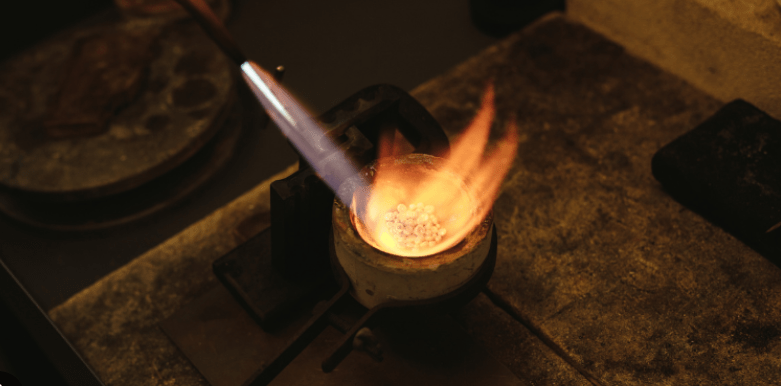
God refines us like silver, burning away impurities to reveal our true, radiant faith.
Refined… We are being mentally and spiritually refined.
God tells us…
- Malachi 3:3: As we discussed, “He will sit as a refiner and purifier of silver; he will purify the sons of Levi and refine them like gold and silver, so that they may present to the LORD offerings in righteousness.” This verse directly links God’s purifying work to the refining process.
- Psalm 66:10: “For you, God, tested us; you refined us like silver.”
- Isaiah 48:10: “See, I have refined you, though not as silver; I have tested you in the furnace of affliction.” This highlights that while the outcome is purity, the method might be unique for each person.
- Proverbs 17:3: “A crucible for silver and a furnace for gold, but the LORD is the tester of hearts.” This emphasizes that God’s refining targets our inner being.
- 1 Peter 1:6-7: “In all this you greatly rejoice, though now for a little while you may have had to suffer grief in various trials, so that the proven genuineness of your faith—of greater value than gold, which perishes even though refined by fire—may result in praise, glory and honor when Jesus Christ is revealed.” This New Testament passage clearly connects trials to the refining of faith.
A blog is generally about shared experiences. I wanted to articulate my experiences with God’s refining work, in order to gain clarity and a deeper understanding. God is consistently working in my life, even through discomfort. As I read His Word, I try to connect the dots between difficult experiences and spiritual growth. I learn best through metaphors… As I contemplated God’s word regarding “refinement” –
Think about this…
As a novice silversmith, I refine silver to eliminate impurities like copper, lead, or bismuth, which can cause brittleness and tarnishing. Pure silver tarnishes slowly and maintains its bright color, while impurities can also affect the melting point and complicate processing.
- The how: I gather my materials, place them in a crucible – you can either use a furnace or use a torch to begin melting the metal. Key points are silver has a melting point.
- You must monitor the temperature – meaning you are there the entire time, mindful, watching, and monitoring.
- The amount of time it takes to melt the silver will depend on the alloy composition, as well as the size of the object that you’re melting.
- You can see the dross as it comes to the top. “Dross” refers to impurities found in precious metals. The dross will compromise the strength and beauty of the material. You can only remove the dross by heating; whatever doesn’t burn up separates from the melted silver and can be scooped away.
- How do you know the silver is ready for the mold? It’s clean and you can see yourself in it…
- Refining silver transforms impure raw material into a high-value, versatile metal suitable for many applications.
Envisioning the silver refining process helps us grasp a profound truth: God never abandons us during our own spiritual and mental purification. God is the silversmith in the visual! Always there, amid our refining – and when He sees Himself, I’m ready…
This vivid metaphor provides a deeply meaningful framework for understanding God’s role in our growth, revealing both how He refines us and why. It reminds us that while the process can be challenging, the outcome is a more valuable, clear, and reflective self.
- This image conveys:
- Intense Heat/Testing: The process of purification involves intense heat, symbolizing trials, difficulties, and periods of correction or judgment.
- Careful Observation: God is depicted as actively and carefully overseeing this process. He doesn’t just put the metal in the fire and walk away; He is intimately involved, ensuring the process achieves its purpose without destroying the metal itself.
- Goal of Purity: The ultimate goal is to remove impurities and achieve a state of purity.
- Target our corruption, lukewarmness, and inadequate offerings
- God’s purifying work will begin with those who are supposed to be closest to Him and lead His people in worship.
- Scope of Purification: these principles extend to all of God’s people. The purification is necessary because, as seen in — including our religious leaders, have grown complacent, unfaithful, and we offer defiled sacrifices.
Why Does God Refine Us?
- To Remove Impurities (Sin and Dross): Just as silver has dross, we have sin, selfish desires, pride, fear, bitterness, spiritual apathy, and other ungodly traits. God’s refining process aims to bring these impurities to the surface so they can be recognized, confessed, repented of, and ultimately removed. With each “trial” we have less and less dross.
- To Build Character: Trials and difficulties, when endured with faith, produce perseverance, character, and hope (Romans 5:3-4). This is the development of Christ-like virtues within us.
- To Increase Our Reliance on Him: Often, in our comfort, we rely on our own strength, wisdom, or resources. The “heat” of refinement strips away these false securities, forcing us to lean entirely on God, deepening our faith and dependence on Him.
- To Conform Us to Christ’s Image: The ultimate goal of God’s refining work is to make us more like Jesus. As the refiner sees his reflection in the pure silver, God desires to see the reflection of His Son’s character in us.
- To Equip Us for Service: A purified vessel is one that God can use more effectively for His purposes. As Malachi 3:3 says, the purification of the Levites was so “they may present to the LORD offerings in righteousness.” A refined believer is better able to serve God and others with pure motives and genuine love.
- To Prove the Genuineness of Our Faith: As 1 Peter 1:7 states, the trials test the genuineness of our faith, demonstrating its strength and resilience.
How Does God Refine Us Mentally and Spiritually?
God uses a variety of “furnaces” and “tools” in His refining process:
- Trials and Afflictions: These are the most common “heat” in the refining process (Isaiah 48:10). They can be financial struggles, health issues, relational conflicts, persecution, unexpected setbacks, or personal suffering.
- Discipline and Correction: Like a loving parent, God disciplines those He loves (Hebrews 12:5-11). This discipline can come through natural consequences of our actions, conviction by the Holy Spirit, or even through the wise counsel of others.
- The Holy Spirit: The Holy Spirit is actively involved in sanctification (the process of being made holy). He convicts of sin, guides into truth, empowers us to overcome temptation, and cultivates spiritual fruit (Galatians 5:22-23).
- God’s Word (Scripture): The Bible acts as a mirror that reveals our imperfections (James 1:23-25) and a guide that teaches us God’s ways, shaping our thoughts and desires.
- Prayer and Worship: Consistent communication with God and focusing our attention on Him reorients our hearts and minds, drawing us closer to His holiness.
- Community (The Church): Being part of a healthy Christian community provides accountability, encouragement, spiritual teaching, and opportunities to practice love and forgiveness. Interacting with others helps expose our rough edges.
Our Response to God’s Refining:
While God is the Refiner, our cooperation is essential. We are called to:
- Submit to His Process: Trust that God is good and His purposes are loving, even when the heat is intense.
- Repent and Confess: Acknowledge the impurities that rise to the surface and confess them to God.
- Persevere: Don’t give up in the midst of trials, but lean on God’s strength.
- Seek Wisdom: Pray for discernment to understand what God is teaching you through the process.
- Embrace Growth: Actively participate in the removal of dross by choosing righteous actions and thoughts.
In summary, the Christian faith strongly affirms that God is actively engaged in the process of mentally and spiritually refining believers. This process, often likened to the purifying of precious metals, uses life’s trials and His divine guidance to remove impurities, build character, deepen faith, and conform us more fully to the image of Jesus Christ, all for His glory and our ultimate good.
- Malachi 3:3 He will sit as a refiner and purifier of silver; he will purify the children of Levi, and he will refine them like gold and like silver, and they will present to Yahweh offerings in righteousness.
- Prov 25:4: Take away the impurities from the silver, and there comes out a vessel for the smith. When the silversmith purges impurities, he can make fine and useful containers
- 2 Timothy 2:20 – 21 – implies that vessels of honorable use require precious materials; these are refined to remove dross.
- 1 Peter 1:7 – He reveals that these trials which cause us grief have a point. They exist for a reason. Peter describes the benefit of these trials, which distress us but don’t prevent us from rejoicing: they test, purify, and prove our faith. When trials come, the believer makes a choice to continue to trust God, in and through the trial. God continues to provide. Our faith grows stronger. (BibleRef)
- 1 Corinthians 3:13 – 14 Paul is stating that the quality of the materials matters because a fire is coming that will reveal all. On the Day of Judgment, every person’s work will be tested by fire to reveal its true quality, and if it endures, the builder will receive a reward.
- Psalm 119:119 declares that God discards the wicked of the earth like worthless dross, which is why the psalmist loves God’s statutes.
Apply it: As we read and study God’s word – practice:
- Self-Reflection: Regularly take time to examine your thoughts, feelings, and motivations -what are you aligning to? Journaling, meditation, or quiet contemplation can be powerful tools. Self-reflection then becomes a dynamic process of aligning yourself with Christ’s character.
- “How can I become more like Jesus in this area of my life?”
- “What attitudes or habits need to be surrendered to God for His transforming work?”
- “How can I allow the Holy Spirit to sharpen and refine my reflection of God’s love, patience, kindness, and self-control?”
- Mindfulness, better yet “God-full-ness”: Practice being present and aware of your internal and external experiences without judgment. This helps you catch negative patterns before they take root. While mindfulness is good, aim to turn mindful moments into moments focused on God. Instead of just observing your breath, link it to a short prayer or Scripture phrase (e.g., “Trust God,” “God’s grace”
- Challenging Negative Thoughts: When a negative or unhelpful thought arises, question it. Is it true? Is it helpful? What’s an alternative perspective? Even when negative thoughts weigh me down, I hold onto the foundational truth that God’s love for me remains constant and unwavering. Acknowledge the reality of the struggle while reaffirming the spiritual truth that anchors you.
- Learning and Growth: Actively seek knowledge, new perspectives, and experiences that broaden your understanding and challenge your assumptions – within our belief in Jesus. True learning and growth in God require acknowledging that you don’t know everything and that God is infinitely vast. Don’t just read the Bible; study it. This means going beyond familiar passages and exploring different genres (history, prophecy, poetry, letters), different translations, and using study tools.
- Embracing Discomfort: Don’t shy away from difficult emotions or challenging situations. These are often the “heat” that brings impurities to the surface. Shift Your Perspective: Instead of viewing discomfort as something to be immediately escaped or complained about, try to see it as an opportunity for God to work. Ask, “What might God be trying to teach me through this?” or “How can this draw me closer to Him?”
- Forgiveness: Holding onto resentment or anger is like carrying dross. Actively practicing forgiveness (of self and others) is a powerful purifier.
- Setting Intentions: Clearly define the virtues or qualities you want to cultivate (e.g., patience, compassion, courage) and consciously work towards them.
- Seeking Feedback: Be open to constructive criticism from trusted individuals. They can often see “impurities” that are blind spots for us.
 Everyday Faith